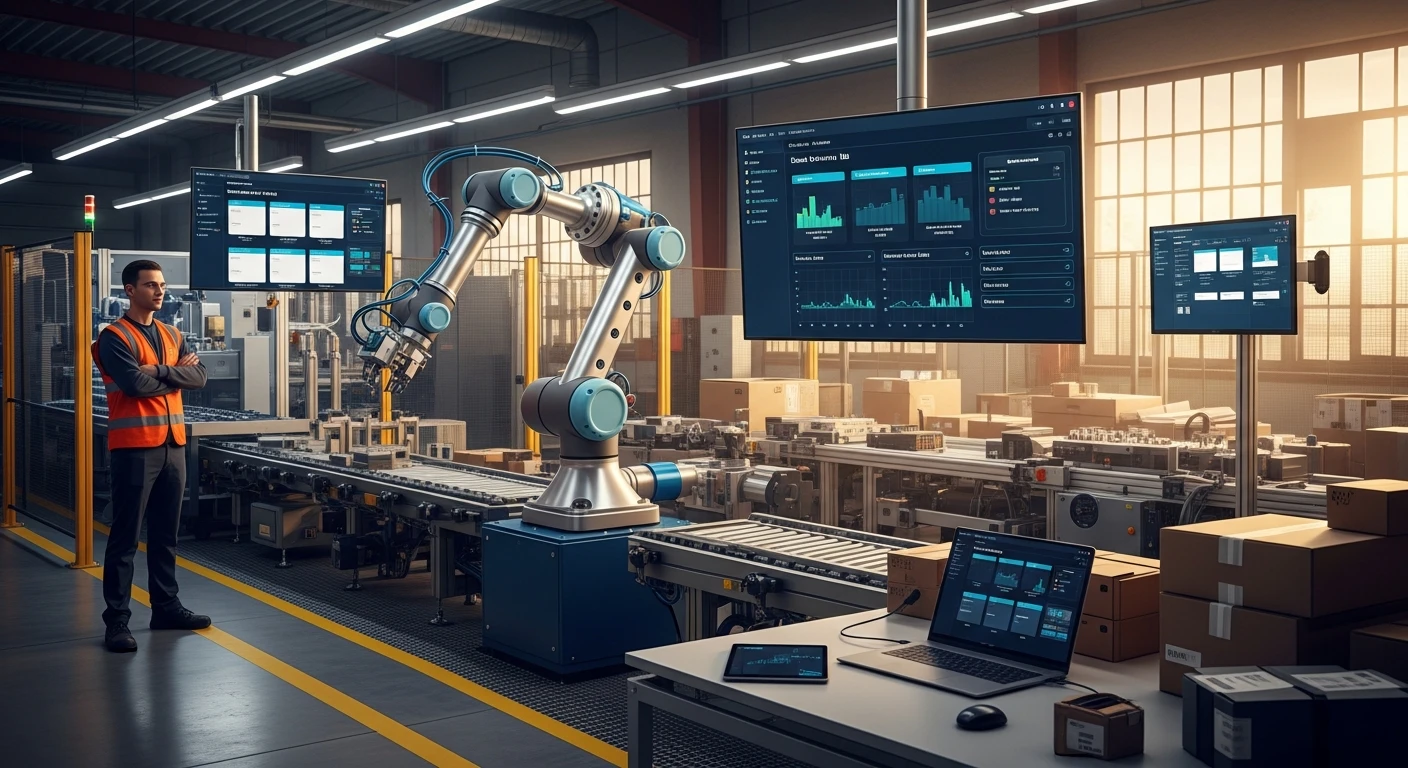
Earlier this month, research by reichelt elektronik and OnePoll revealed that 35% of Dutch industry works with cobots and that 37% plans to invest in these flexible robotic arms within two years. This puts cobots at the top of the list of planned robotics investments, followed by mobile robots and stationary robots. The picture seems accurate: Dutch manufacturing is automating, and the barrier to entry for robotics is lower than ever.
At the same time, ING published a sector analysis in February 2026 containing an uncomfortable figure. Only one in five Dutch manufacturers actively uses AI, and the real value of industrial software capital has declined by 7.5% over five years, while the Netherlands broadly grew by 8.5%. Two studies, one pattern: we are happy to buy hardware. Software gets left behind.
The comparison that chafes
The most painful figure doesn't come from the Netherlands itself, but from neighbouring countries. In Belgium and Denmark, nearly 40% of manufacturing companies use AI; in the Netherlands, the counter stalls at 29%. The same type of manufacturing industry, comparable scale, comparable challenges around staff shortages and competitive pressure — different choices. ING openly describes it as a lag behind the European frontrunners.
What explains that difference? Not technology, not money. The difference lies in what we dare to buy. A cobot can be pointed to on the shop floor. It stands there, it moves, it visibly replaces work. Software is invisible, and investments follow what is tangible. That is understandable, but it costs productivity — academic research cited by ING shows that AI implementation can increase annual productivity growth per employee by up to 3 percentage points.
What a cobot actually is
This is where it gets interesting. A cobot is not a machine. It is a sensor with arms. Every movement it makes generates data: cycle time, torque, acceleration, deviation, energy consumption. Anyone who installs a cobot without doing anything with that data stream is buying half of what they are paying for. The action has been automated, but the knowledge the machine generates remains sitting on the shelf.
That is where the logical next step lies: predictive maintenance on the cobot itself, anomaly detection on the process, and process learning across workpieces. No additional hardware required. No multi-million-euro project. The data is already there, just not connected.
Budget is no longer the excuse
For anyone who still thinks AI is something for Shell and ASML: the average AI investment among Dutch SMEs is around €35,000, with an average payback period of eleven months. That is less than half a cobot. The barrier is no longer money, nor technology. The barrier is that we don't know where to start, while in the meantime we keep investing in what we know.
I see it regularly in practice. Companies with a new cobot, a fresh WMS, an ERP project behind them — and no idea what to do with the data from those systems. The infrastructure is in place. The piece that makes the infrastructure smart is missing.
The question for 2026
Dutch industry is not standing still. 79% now uses some form of robotics. But the ING report shows that we are not supplementing these investments with the software that makes them profitable. Cobots optimise muscles. AI automates judgement. The first without the second is half a transformation.
If you are investing in robotics, the question is not whether you should also invest in software. The question is why you haven't done so yet.
Sources
- reichelt elektronik & OnePoll, "Cobots increasingly popular in Dutch industry", April 2026 — via Maakindustrie.nl
- ING Sector Banking, "Dutch Industry missing many AI opportunities", February 2026 — via industrievandaag.nl and accountant.nl
- Searchlab, "AI in the Netherlands Statistics 2026" — based on CBS, McKinsey and NL AI Coalition